
We aren’t the least not unconfusing authors. We admit that. So for us, it isn’t always a gas reading Kenneth Burke. A sentence like this one becomes a tumbleweed of confusion:
A is not identical with his colleage, B. But insofar as their interests are joined, A is identified with B. Or he may identify himself with B even when their interests are not joined, if he assumes they are, or is persuaded to believe so. (Burke 20)
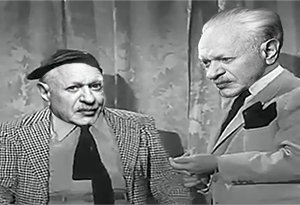
It’s sort of like that Abbott and Costello routine on baseball, don’t you think? Abbott could have just said, “A is on first and B is not,” though it wouldn’t have been as funny. Similarly, we wish Burke would have just said, “People who are not the same but share similar interests identify or are persuaded to identify with each other.” Again, it may not have been as funny.
Nevertheless, we find Burke’s theories on language and bodies helpful in examining material rhetoric and digestia. We feel similarly to the way Celeste Condit feels about Burke and how his work connects to material rhetoric. She notes that part of his famous definition of humans points to a materialist theory of rhetoric: “bodies that learn language.” In a sense, Burke’s pithy statement suggests a fuller theory of language Condit calls for in which “meaning is something real, something material, and not merely a function of a disembodied spirit or mind” (336). Condit further speculates that “it is possible to read Burke’s notion of ‘substance’ as consonant with materialist epistemology (353). And we agree. We take Burke’s concepts of substance and consubstance and play with them. We imagine ways in which these concepts connect more directly to material rhetoric—to bodies—and knowing when rhetoric has occurred. Applying Burke’s concepts allows us to take a familiar framework and apply it to rhetorics of bodies and see the effects of bodily communication, or the restrictions placed on it, in the world around us. In a sense, we examine not only the bodies that learn language but the language that learns or teaches bodies.
Consubstantiation
Regardless of the confusion, the description of identification is an important move for considering digestia rhetorical because Burke connects identification to the concept of consubstantiality:
A doctrine of consubstantiality, either explicit or implicit may be necessary to any way of life. For substance, in the old philosophies was, an act; and a way of life is an acting-together; and in acting together, men have common sensations, concepts, images, ideas, attitudes that make them consubstantial. (Burke 21)
In a more understandable phrasing, Daniel Fogarty explains consubstantiality like this: “Things or people, different in other ways, may have one common factor in which they are consubstantial or substantially the same” (74). These factors result in common sensations that generate consubstantiality. Consubstantiation describes how symbols are used rhetorically to produce identification.
In language these similarities are voiced orally. When people proclaim that “nature calls!” or admit that “when you gotta go, you gotta go” they are at once creating euphemisms for passing waste, but also acknowledging common experiences and sensations that they share or act-together with others, no matter how inconvenient (after all “when you gotta go…”). At the same time consubstantiation also produces division. So by acting-together it also means that one is acting-separately from audiences who might not share digestia decorum. For instance, the way flatulence is phrased or euphemismed also creates consubstantialiity and division. A person who uses the more polite “passing wind” in a particular situation might mean he/she is not consubstantial with someone who uses the less polite “crop dusts” in the same situation.
Flatulence itself also produces consubstantiality and division. For instance, one is consubstantial with others who do not pass gas at “inappropriate” times or in “inappropriate” spaces. In a sense flatulence is kairotically (right place, right time) consubstantial. Division is produced by not removing oneself from situations or contexts where it is “inappropriate” to pass waste or flatulate. Public displays of such acts create division. They deviate from what is seen as a normal way to deal with these types of bodily functions. Pooping at the dinner table will probably divide you from a lot of people in many contexts. Using Beano, then, as a representation of digestia is a rhetorical move that, like language, helps one consubstantiate with another—control gas so one can pass it “appropriately.”
Substantiation
For us, however, rhetoric isn’t just about acting-together and acting-separately or consubstantiality. Rhetoric is also substantial. “Substance” as Burke notes is “an abstruse philosophic term, beset by a long history of quandaries and puzzlements” (21). And we do not have the intestinal fortitude to discuss this long history. However, we do want to explain how rhetoric and, thus, digestia is substantial—how material substance and/or bodies are rhetorical. Burke, again, provides a theoretical understanding of this concept though he does not use the term substantiation. Substantiation describes how signs are used rhetorically.
In her entertaining and insightful work Moving Bodies: Kenneth Burke at the Edges of Language, Debra Hawhee does what many scholars have ignored and discounted in their discussions of Burke: Burke’s theory on the body and how after completing A Rhetoric of Motives, “Kenneth Burke turned his attention to shit” (125). One scholar, William Rueckert, even demeaned his work, saying Burke possessed “adolescent motives,” that caused him to be “turd-brained and pee-headed” while working on his ultimately unfinished conclusion to the Motives trilogy (qtd. in Hawhee 126). Like Hawhee, we feel Burke's analysis of the body is important for helping us understand how bodily functions are powerful communicators and persuaders and how substance is itself rhetorical.
Burke spent a great deal of time corresponding about various bodily ailments and movements, among which was a heart or throat condition he named and described as gaspo-gaggo-gulpo, presumably for the reaction it elicited: Gasp! Gag! Gulp! These numerous, annoying, and sometimes dangerous symptoms were so impactful to Burke’s work—both as a contributor to his thinking and an impediment to his progress—that Hawhee describes his bodily communications as his “disruptive guide” (129). This “disruptive guide” is substantial: it is the physical changes in bodies that occur as a result of ingestion and digestion. As Burke notes, his thinking—his symbolic ideas—were disrupted; in more symbols, rhetoric was disrupted through the body. In other words, and as we describe in “Issue #1: Digestia,” bodily signs cause and influence symbols and symbolic thinking. They communicate.
Hawhee describes Burke’s body rhetoric as “transference—the spreading of body-thinking from body to body” consisting of three necessarily linked and equal agents: “the body of the artist that ‘inspirits’ the words; the purging bodies of dramatic characters…; and the chuckling, sobbing bodies of readers” (140). Language, according to Burke, and therefore persuasion as well, depends on motion (159). “Moving bodies” and actions taken by bodies are intrinsically linked to symbols (143). It is these intertwined components that we see as playing a central role in the rhetorical nature of flatulence and passing waste. Because a moving body - in this case gas and/or waste - is in Burke’s view dependant and interconnected to the symbolic, attempts to control or hide bodily functions is a use of signs (the "intrinsic" for us) and symbols to craft communication.
Passing waste, for example, seems to have "solidified" itself as a taboo action through the privacy measures taken to hide the action (e.g. outhouses and bathrooms). Such privacy measures or "hiding" of the action has resulted in gender-specific, societally demanded, rhetorically constructed self-images that claim bowel movements do not exist. In Western culture this trend began in the Victorian era, in England and United States, where "fecal denial," or the act of hiding away waste and the fact that humans must pass it, became a widely held cultural norm. Dave Praeger explains in Poop Culture, "The state and other ideological apparatuses (churches, schools, etiquette guides, magazines, etc.) encouraged people to accept flush toilets by vilifying those who didn't. To poop in a close-stool, a chamber pot, a privy, or any other outmoded plumbing was to be savage" (55). Products like Beano which are symbols of quelling gaseous discomfort facilitate creation of this "fecal denial" by making control over bodily functions possible, and, thus, the creation of self identity and identification with others, easier. Similarly, Burke’s “Beauty Clinic,” which Hawhee describes as “the tendency to clean ourselves up in thought and body" reveals Burke’s parallel between physical actions that are catered to the human experience and the communicative actions we take to alter the way these movements are perceived by others. Beano is not just symbolic; it is also sign-bolic. It is a substance that works to control other signs (i.e. bodily functions such as flatulence and gustatory discomfort) and symbols (i.e. flatulence as “funny” or “rude” and gustatory discomfort adjusting symbolic behavior).
Additionally, in A Rhetoric of Motives, Burke explains that rhetoric is not limited to the use of language, but anything that has meaning. He addresses the ingestion of food specifically when he points to the fact that the meaning of a given food, as a symbol, communicates (173). Beano did not exist when Burke wrote A Rhetoric of Motives, but he would certainly agree that the decision to eat or abstain from a given food for what it symbolizes—in the case of the vegetable plate, impropriety resulting from gas—is clearly rhetorical.
Covering up or otherwise dealing with the inevitability of this taboo is rhetorical, and especially kairotic, heavily employing substantiation, since bodies and the products we take to control them alter when, where, and how people communicate. Products like Beano employ substantiation in the way they allow communication to proceed unencumbered by gas and waste. Beano is also substantial, and therefore rhetorical, in how its use is a form of communication with a body to control it. As a sign, Beano is, again, used to communicate.
Transubstantiation
So far we have discussed consubstantiation—how one shows he/she is like and or shares something in common with someone else—and substantiation—how substances like Beano affect bodies rhetorically. There is one other term we believe is important for understanding our view of rhetoric and digestia: transubstantiation. As with substantiation we are not interested in the philosophical or religious discussions about the term. Instead, we are interested in the conversion aspect of transubstantiation—how one substance is converted into another. Transubstantiation is a term of conversion describing how symbols sign—how symbols convert to signs—and how signs symbol—how signs convert to symbols. Transubstatiation describes how consubstatiation and substantiation are connected. In other words, we quite literally ingest and digest symbols and signs.
J.L. Lemke offers an explanation of transubstantiation in his description of the importance of the social environment on our behaviors and experiences in the world:
From shortly after birth (and maybe for a time before), and all during the life of the organism, one of the most important environments in which the adaptive patterns of the species (our evolved, genetic patterns) become the actual behaviors of individuals is our social environment: the patterns of contacts with other members of our own species. We do not inherit behavior with our genes; we inherit only chemical possibilities. These possibilities become us through the direct and indirect interaction of our chemistries with their/our environments: with the food we eat, the climate we live in, the sunlight and other energies to which are are exposed and a thousand other factors—but critically important among all of them is our interaction with other human beings. (Lemke 160)
Lemke emphasizes the interaction between the body (“chemical possibilities”) and our social selves. He notes that our social selves have bodily effects that make us “become us through direct and indirect interaction with our environments…” and observes, “that we know that social interactions can lead to hormonal changes and differences in the level of oxygen in our brain” (161). Rhetoric or communication (i.e. social interaction with other human beings) is “ingested” and “digested,” or symbols have bodily effects.
Lemke would most likely dispute the epigram: sticks and stones may break my bones, but words will never hurt me. Words or other symbols and signs like sticks and stones, do hurt; they both have bodily consequences. Although we are not as ready to concede everything to the social as Lemke with regards to matters of genes, it is difficult to determine where culture stops and biology begins. It is difficult to determine how words, images, pictures, or symbols, in general, do not sign or produce bodily effects. After all, “Who’s on first?” is a skit of symbols that makes us laugh and A Rhetoric of Motives is a book of symbols that makes us cry. Similarly, it is difficult to understand how signs like bloating, sadness, happiness, and a raised heart rate do not produce symbolic effects (i.e. different symbolic behaviors or interpretations of behaviors and actions). After all, that laughter at "Who's on first?" and that sadness from A Rhetoric of Motives influences how one symbols.
Transubstantiation is an acknowledgment that what we often consider immaterial symbols (e.g. verbal text, visual text, audio text) have sign or bodily consequences. Though it seems obvious, we believe it is important to remember that symbols cause signs and have real effects on people. Words, like Beano, affect bodies.

A rhetorical triangle we hope Kenneth Burke and Abbott and Costello would approve of.