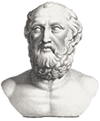

"[Rhetoric] is the 'art of enchanting the soul.' (The art of winning the soul by discourse.)"
Pretty spiritual and competitive interpretation of the world, Plato.
***All comic theorist definitions provided by "American Rhetoric."***
Not bad and pretty inclusive but it's all about "persuasion." No wonder rhetoric has such a bad rap, Aristotle. Who are you going to trust?

"Rhetoric is the art of
speaking well" or "
...good man speaking well."
Oh, Quintilian. Pretty limited worldview. - limited to "speaking." What is "well"? And can't women speak well too?


Rhetoric is the art, practice, and study of human communication.
Very inclusive, Lunsford. It’s art, practice, and study. But it isn't non-art or science or product or non-study. Can it happen when a rhetor isn't arting, practicing, or studying?

Definitions of rhetoric are legion. A Google search lists a number of links to definitions or to authors curating definitions. The online journal Harlot: A Revealing Look at the Arts of Persuasion holds an annual Twitter competition (#definerhetoric) that acts as a metacomment on rhetoric's slippery nature and scholars’ disagreement over what rhetoric is and/or should encompass – be the study of. For us, such diversity in defining rhetoric is a strength of the discipline. Such diversity affords rhetors to fresh insights, appreciation for, and understanding of different worldviews and value-systems on communication and interpretive practices.
This perceived strength, however, often seems to give presence to particular material aspects of rhetoric while absenting others. In other words, what seems to be foregrounded in common or popular definitions of rhetoric or analytical practice is an underlying assumption about what rhetoric deals with: words, pictures, and sometimes sounds. Importantly, rhetoric deals with symbolic practices that encompass non-discursive symbolization. Joddy Murray describes non-discursive symbolization as “a term that accounts for the many other ways humans use symbols to create meaning-methods wholly outside the realm of traditional, word-based text” (12). While certainly we appreciate how rhetorical analysis includes a spectrum of symbolic practices beyond words, what gets absented or backgrounded are the other “sensual ways information reception can be rhetorical: visual, haptic, aural, olfactory, and gustatory” (Murray 8). Digestia, then, is our way to make present and open up analysis about bodies and the material rhetoric of olfactory and gustatory communication. We want to point out that rhetoric isn’t just inscribed outside of bodies; it is even part of our digestive practices.
By the very fact of selecting certain elements and presenting them to the audience, their importance and pertinency to the discussion are implied. Indeed, such a choice endows these elements with a presence (116).
Absence, then, occurs to those elements that are not selected and not presented to an audience.
[X]
[X]

Rhetoric is "the faculty
of discovering in any
particular case all of
the available means
of persuasion."
Not bad and pretty inclusive but it's all about "persuasion." No wonder rhetoric has such a bad rap, Aristotle. Who are you going to trust if you're always being persuaded about something?
We, however, want to be clear about our take on rhetoric. Our definition for The Daily Gas remixes a popular definition of rhetoric from our graduate school days. We decided to critique this definition because it offers us a way to examine symbols and separate them from signs. Such a move allows us to show how material rhetoric is connected to digestia. Our definition comes from Foss, Foss, and Trapp’s important work, Contemporary Perspectives on Rhetoric. The piece summarizes a variety of rhetorical theorists' work, concepts, and value-systems. In their introduction, Foss, Foss, and Trapp define rhetoric inclusively and seem to be trying to synthesize or create a comprehensive definition of rhetoric based on their understandings of the theorists they summarize. For Foss, Foss, and Trapp rhetoric is “the human use of symbols to communicate” (1).
In their work, Foss, Foss, and Trapp discuss the major parts of their definition (humans, symbols, and communication) and thoughtfully articulate the presences and absences of their choices (i.e. what values are emphasized and what values are being minimized). While we don’t necessarily completely agree with their use of “humans” or with their use of “communication,” these are not the points of contention we want to hone in on. For us, the main problem with Foss, Foss, and Trapp’s work is their quick dismissal of material in their definition of rhetoric. For us, their definition should include material: human use of signs and symbols to communicate. Otherwise, digestia is not possible and it becomes easy to ignore olfactory and gustatory non-discursive communication practices.
For Foss, Foss, and Trapp, signs refer to things that are not necessarily conscious. Signs have a direct connection to what is being presented—like Pierce's indexical signs "which signify by causal connections" (Berger 10). To be clear, we interpret Foss, Foss, and Trapp to be using signs in the semiotic sense and its relationship to a referent. We do not take them to be using signs in the Aristotelian sense and its relationship to proofs and argument. In Foss, Foss, and Trapp's example, which is supposed to illustrate the difference between sign and symbol, they note how a heart attack’s symptoms—“heart rate and rhythm”—are signs a person cannot control. Symbols, on the other hand, are “human constructions connected only indirectly to its referent[s]” (2).
For Foss, Foss, and Trapp, symbols are usually used deliberately but can also be associated with actions that are not deliberate where symbolic value is interpreted. Foss, Foss, and Trapp do not explain how a heart attack could be triggered by a symbol—by “emotional stress or pain” (National Heart Lung and Blood Institute) caused by and through symbols. This is an important relationship to consider: a symbol can result in a sign, which makes it a result of rhetoric. Doesn't this make it rhetorical, a human use of communication? After all, don't rhetors often move audiences into signs—changed "heart rate and rhythm"? And don't words (symbols) result in emotions (physical change in the body or signs)?
Material rhetorical advocate and early theorist of material rhetoric Michael Calvin McGee puts his understanding of how rhetoric is material in this way: “But the whole of rhetoric is ‘material’ by measure of human experiencing of it, not by virtue of our ability to continue touching it after it is gone” (23). For McGee, rhetoric “was not material in the sense of a ‘thing’ like a rock or tree, but rather as a palpable and undeniable social force” (Biesecker and Lucaites 3); rhetoric is material because of the experience of force. While we agree with McGee’s position, we follow Celeste Condit’s lead in suggesting that a more directly “physical component” be added to McGee’s materialistic view. Condit in her conception of materiality and material rhetoric smartly points out that “human meanings arise from the specific histories of their cultures, but also from the specific material limitations of human bodies and environments” (338). Considering the material constraints and affordances of bodies and the ways in which bodies are manipulated and articulated, it seems that results of experience or of force are very physical.
Gorgias’s Encomium to Helen sheds light on the complicated relationship between signs and symbols. In Gorgias’s description of how “it was possible to see how the force of persuasion prevails” he shows how rhetoric is quite bodily-quite physical. For Gorgias, rhetoric is as powerful as a physical force and is very material. Rhetoric is bodily. He writes:
For just as different drugs dispel different secretions form the body, and some bring an end to disease and others to life, so also in the case of speeches, some distress, others delight, some cause fear, others make the hearers bold, and some drug and bewitch the soul with a kind of evil persuasion. (46)
Though he does not make this claim directly, Gorgias suggests that symbols cause signs. Furthermore, he makes an implicit argument that signs result in symbols. In more words, we can consider how signs, like drugs dispelling secretions from the body—i.e. controlling the body—result in discursive symbols or a particular type of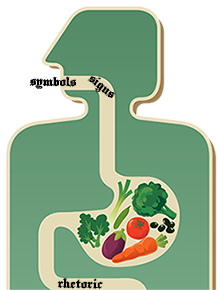 speech. Pork and Beans, for instance, can be considered a symbol for flatulence. Beano is a symbol for controlling flatulence. When ingested and digested deliberately Pork and Beans (as sign) dispels a particular secretion from many bodies that can communicate deliberately (symbolically) or whose value can be interpreted. A sign causes a symbol. Similarly, when deliberately ingested and digested, Beano (as sign) controls the dispelling of a particular secretion that can communicate deliberately (symbolically) or whose value can be interpreted or experienced.
Again, we offer our critique and re-writing of Foss, Foss, and Trapp’s definition of rhetoric as a way to understand rhetoric’s materiality and offer an alternative worldview and value system regarding what rhetoric is and does. We want to give presence to the notion that the boundaries between symbols and signs and between rhetoric and bodies are not clear-cut. And we offer our alternative definition as a way to emphasize the rhetorical import of a few aspects of non-discursive rhetoric that get overlooked. Digestia is our term for synthesizing these ideas and is a rhetorical lens for analyzing ingestion and digestion of food and food technologies as rhetorical acts.