Likin' & Rhetoric
Download video: MP4 format | Ogg format | WebM format


Synecdoche
We think “Like” is a really useful synecdoche. And synecdoche is one of Burke's master tropes (i.e. a really important verbal technology/rhetoritechnology for communicatin'). For Burke (1969b) synecdoche is a way to communicate by representin'
a part for the whole, a whole for the part, container for the contained, sign for the thing signified, material for the thing made..., cause of effect, effect for cause, genus for species, and species for genus, etc. (p. 508)
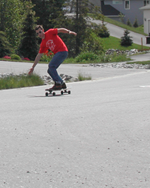
Now, if you think too much about Burke, you're gonna get confused, so think about it like this: if you look at that picture to your right of the really handsome skateboarder (human or canine, there's no specism here!), you'll notice that it's a synecdoche or a part for whole. What we mean is that if you consider how the picture is cropped so you don't see the dog-catcher in one picture or the policeman in the other you'll see only part for whole. It's funny though cause at the same time that picture is a part for whole, it is also a whole for part. If our purpose is to represent a skateboard, then that dog and dude are gettin' in the way. Synecdoche is dependent on how you're usin' it within a larger or smaller context and is a process of selecting and cropping.
The "Like" button isn't too much different from a picture. It's sort of like a picture of your perspective. If you’re ready to like something whether it's a comment about the weather, a picture, or a video of a skateboardin' dog, clicking the “Like” button is a rhetorical move sending a message or representin' to your audience that you like part of something or a whole of something. Burke might say we’d be inducing an attitude or emotion to our audience based on what we like. So if you click “Like” for a video of a skateboardin' dog, I’m ready to call you, "friend!"
But, whoa! What’s greaTerrible about “Like” as a synecdoche is its ambiguity. When you like that video and you click that “Like” button, you are making a very ambiguous statement. When you click “Like,” you could be sayin’ that you are “Like" the whole video or you “Like” that this is a dog skateboardin'. Or you might even be sayin’ you "Like” skateboardin' dogs in general. In fact, you might just be sayin' you "Like" that part of the video where the dog gets back on his skateboard. Heck, you might even be making a clever analogy: “I am very ‘Like’ a skateboardin' dog!” (pluck the orange petal for more about interpreting "Like"). Just like those pictures of a dude and dog skateboardin', to "Like" is selecting and cropping and deslecting and magnifying a representation or a message. It's hard to tell exaclty what's bein' communicated though.
Sound/Speed
Kjartan Müller (2011), in his research on digital media, genre, and design, calls Fb’s “Like” button a “one-click-dialogue[s], that is, feedback in the form of one button click” (p.191). He writes that this form of communicatin' “is a social communicative action in the form of a minimal typified response in a specific rhetorical situation” (p. 191) and that "Like" frames the world as a unary. It's not even a binary. You get to choose "Like" or nuthin'. "Like" that skateboardin' dog or________.
Considering "Like" as part of a dialogue is hard to swallow too. We always thought of a dialogue like this: "to take part in a conversation or discussion to resolve a problem" (Oxford). The way Müller uses dialogue is more general and might mean something more like this: "to take part in a conversation or discussion to receive feedback." We don't have a problem with this larger definition. After all, when we post a picture of a skateboardin' dog, we don't exactly have a problem. We just wanna share with our friends and see what they have to say. What we do have a problem with is the "take part" part. When a unary is the only choice available, Fb isn't so much allowing users to manipulate beliefs or induce actions as it is coercing users into actions and attitudes. We aren't exactly sure if this makes the clickity-click of "Like" a very meaningful and/or rhetorical act for users (audiences), but we know it's rhetoric for Fb cause it's their design, their manipulations, and their inducing of actions and attitudes.
But if we do read "Like" rhetorically then "Like" encourages us to click (act) and respond minimally without too thoughtful participation (attitude). Why type a comment about a skateboardin' dog when you can quickly click “Like"? And because "Like"ing is a positive term, which has "good" vibes and connotations, we could even consider "Like" as rhetorically inducing "good, good, good VIBErations."
To be fair, sometimes "Like" can encourage a comment. When you "Like" a comment box can pop-up. However, this isn't required and, on a lotta websites with "Like" buttons or even on comments in Fb itself, you can just click "Like" and aren't encouraged to engage beyond a clickity-click. Fb, though, to its credit, encourages dialogue in how it uses the "Like" button on resources pages. If you scroll to the bottom of the web developers page, you'll see Fb wants users to say something about your "Like."
However, it isn't as if we can "Like" the other way around on web pages. What I mean is while there is a "Send" button that let's ya comment and send a link, to "Like" is to first "Like" and then comment. It ain't the other way around where a user comments first and then chooses whether to "Like" or_______. So in this sequence of actions "Like" is a rhetorical move inducing us to act quickly. Writing or a more thoughtful response is not really encouraged. To "Like" without a comment seems more like a monologic response than a dialogic one; we don't really expect engagement or conversation once we "Like."
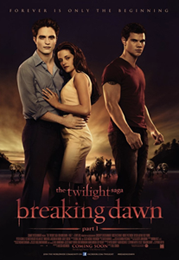
We think “Like,” can be considered a LOUD rhetorical feature of Fb since, well, it exists, comments are sort of discouraged, and “Dislike” doesn’t exist. We mean "Like" really is THE rhetorical choice for clickin', dialoguin', and meanin' so much. Silence just isn't the same when there isn't an option for clicking "Like" or "Dislike." It might even be helpful to have the option for clicking "Like" and "Dislike" at the same time. After all, it seems pretty rare to either/or something completely—to completely like or dislike something. Don't you like Edward's hair and Jacob's body? And don't you dislike Edward's creeping and Jacob's obnoxiousness? And isn't Bella likeable (great hair!) and dislikeable (a little needy)? To be silent and not select anything can be even more confusing than having a button. At least with a binary—with a "Like" and "Dislike"—you get a sorta, kinda, like-a, bead on things. You don't get this with silence.
What you can do on Fb is "Unlike" something you may have already "Liked." But this is similar to silence. It’s ambiguous and doesn’t really mean that you “Dislike” something; it just means that you’ve decided not to “Like” it anymore. And it's silent. There is no trace of it. Once you "Unlike," there isn't a comment or indication saying, "Paula Alquist 'Unliked' our picture." Without a trace and/or without taking screenshots of Fb pages, it becomes really difficult to remember what's happened—who's "Liked" and "Unliked." After all, Fb pages are dynamic and changing and updating. It's difficult to trust memory. We like to think of the rhetorical move that the dynamic content of Fb pages and the web in general makes as gaslighting. In more of our words, dynamic content and updates can make ya think you're going mad because ya can't trust your own memory and digital memory seems so complete, up-to-date, and accurate (e.g. Did Paula Alquist "Unlike" this our post? We can't remember; it isn't on Fb and we think the numbers of "Likes" on this picture are the same, but maybe they aren't...We trust the credibility of the web; we, like, assume the Interweb remembers what we forget.).
LikeLessons
To "Like" is a synecdoche.
To "Like" is LOUD. Silence is confusing.
To "Unlike" can gaslight.