Dislikin' & The Message
Download video: MP4 format | Ogg format | WebM format

Negativity
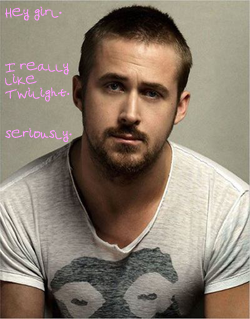
The current structure of Facebook’s community is layered with text, images, video, and links. When a user views one of these mediums, that user can also see if other users “Liked” the medium. So a post with a large number of “Likes” has created a mini-community of users who are in agreement about their liking of the post. When we “Like” the new Twilight movie and Ryan Gosling “Like"s the new Twilight movie, there, in front of us, is a visual confirmation of our shared liki-ness. Wow! We have somethin' in common with Ryan Gossling, awesome!
But wait just a minute. When you "Like" something and we "Like" something, what about those who don’t "Like" that something? They're absent from this interaction. The “Like” button is a terministic screen. It directs attention to the "likiness” while deflecting attention away from the “dislikiness.” As Burke (1969a) reminds us “…any nomenclature necessarily directs the attention into some channels rather than others” (p. 45).
So what if we don’t like the new Twilight movie? The absence of a "Dislike" button means that we are ostracized from that community. Now, we have nothing in common with Ryan Gosling. He "Like"s it, we don’t. But there’s no button or visual marker for us. We are now absent from this interaction on Fb. The visual marker of the “Thumbs up” along with the number of "Like"s creates a moment of conflict for users that “Dislike.” The thought process may look something like this: Why don’t I like this post? Am I different from these other users? I should say something, but then my comment is there for everyone to read. No one else said anything. I must be the only one. Ok, I just won’t say anything then. I guess I don’t have the right to dislike this.
The user could interact with this community through a written comment, but that still sets the user apart from the users who have been invited into this mini-community of liking by clickin' a button. As Chris Pirillo notes in his YouTube segment when he sees a post he doesn’t like, he does nothing. He doesn’t comment. We believe this is because commenting sets you apart. It requires more time and energy, and it marks your difference from the "Thumbs up” likers whose clicks visually, numerically, and, thus, vaguely represent a "Like." But that “Thumbs up” carries a lot of weight. McLuhan (2005) states “We insist on employing visual metaphors even when we refer to purely psychological states…We are so visually biased that we call our wisest men visionaries, or seers!” (p. 117). Whoa, that “Thumbs up” speaks volumes cause we can see it and, often, count it—see numbers of "Like"s. So a “Thumbs down” would amp up the volume for the dislikers. We know there's strength in pictures and numbers.
And what about the original user who posted the content? When the post meets with a large number of "Likes" and no negative comments, the user feels acceptance and encouragement from this mini-community of likers. So the “Like” button directs the poster’s attention to all positive reactions and away from any negative ones. It's all about likin'.
We think all the likin' creates a false sense of unity – the poster isn't confronted with any opposition and might assume compliance/agreement from the Fb community at large. Naysayers are pretty much absent. So, yeah, this maintains the “positivity” that bloggers argue is important to Fb, but there is no complication, no dialoging, no engagement. Burke (1969a) tells us:
For, strictly speaking, there will be as many different world views in human history as there are people...We can safely take it for granted that no one’s ‘personal equations’ are quite identical with anyone else’s (p. 52).
In our words, nobody "Likes" in exactly the same way, despite what Fb tells us. A "Dislike" button may actually draw attention to unlikeness and help us see that we've got at least a binary of world views rather than a simple unary. A "Dislike" button might even result in more dialogue and commenting between users about individual likes and dislikes beyond the either/or or like/dislike binary and become a better space for Fb users to share their multiple and complicated world views. And that aint' a bad!
Expediency
Things move pretty fast on Fb. Within a few minutes, there are new posts, photos, videos, likes, and comments. To “Like” is quick and easy. To “Dislike” currently means we gotta write a comment. We gotta explain ourselves. Who has time for that?! Fb doesn’t think we do. In fact, while we're composing our “Dislike,” any number of peeps can click “Like” and move on. “Like” moves faster than “Dislike.” Why write when you can click? McLuhan (2005) tells us “We can no longer build serially, block-by-block, step-by-step, because instant communication insures that all factors of the environment and of experience coexist in a state of active interplay” (p. 63). Things happen simultaneously on Fb – there is no series of events. Writing requires you to build your comment in a linear fashion, word-by-word. Clickin' a button happens in an instant. Therefore clickin' is better than writin'. Writin' just ain’t expedient!
But hold on just a click! Doesn’t this reduce our social interaction to nothing more than empty, positive clicks? How much time are we actually spending interacting with our Fb friends? Sherry Turkle (2011) argues that online social interaction can degrade our experiences (both virtual and actual):
We can write that Facebook profile that pleases us. We can edit our messages until they project the self we want to be. And we can keep things short and sweet. Our new media are well suited for accomplishing the rudimentary. And because this is what technology serves up, we reduce our expectations of each other” (p. 12).
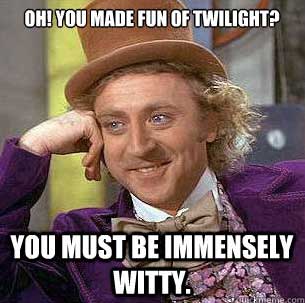
Now a “Dislike” button would definitely be expedient, but would it lead to more meaningful interaction? We think it could! Why? Let’s bring it back to ambiguity and false positivity. Say we repost Condescending Wonka’s meme about Twilight. The "Like”s start pouring in. But then, wait! Ryan Gosling clicks “Dislike”! Why?? We decide to ask him. And he responds. And then another friend jumps in to defend Twilight. And Ryan Gosling responds. And then another friend trashes Twilight. And then we respond to justify our post. And Ryan Gosling responds. And then we see his point of view but still think Condescending Wonka is funny. We have just interacted with our Fb friends using clicking and writing. We know more about why some friends “Like” my post while others “Dislike” it. Sure, it’s still rudimentary but we have all done more than just clickity-clicked and moved on.
DislikeLessons
To “Dislike” is to encourage complication and dialoguing.
To “Dislike” is to reduce false unity and false positivity.
To “Dislike” means inclusion and visual representation.