Dislikin' & Rhetoric



Metonymy
Burke (1969b) tells us “The basic ‘strategy’ in metonymy is this: to convey some incorporeal or intangible state in terms of the corporeal or tangible” (p. 506). He provides this example: "to speak of 'the heart' rather than 'the emotions' (p. 506). So "heart" is tangible and communicates "emotions," which are intangible (i.e. vague, abstract, or don't have a physical presence). But "heart" didn't always communicate "emotions." Sometime way-back-when, someone created that connection, that metonym. So metonymy helps us convey "some incorporeal or intangible state in terms of the corporeal or tangible" through seemingly unrelated objects, ideas, etc.
Metonymy happens in pictures too. For instance, the picture of planking next to the Statue of Liberty shows a visual metonymy. The Statue of Liberty (tangible) can be patriotism (intangible), a seemingly natural association, but it's not. It had to be created. Say the planker over there is trying to convey planking as patriotic. Perhaps, he's even mocking patriotism. Regardless of purpose, the planker may be read as using the Statue of Liberty to be a metonym communicatin' patriotism. After all, you can’t plank next to patriotism! Ah, but you can plank next to an accepted tangible symbol of patriotism (the Statue of Liberty). And, like Burbules points out in his discussion of metonymy (1997, p. 112), if this connection is repeated enough—say you have pictures of planking next to patriotic monuments all over the country—then patriotism might transfer onto planking. Planking, like the Statue of Liberty, could be a metonym for patriotism. Can you imagine planking the 4th of July instead of fireworking it? Now, planking seems to be a metonym for Internet time-wastage or fun, depending on the context. A hater might say, "The Internet is full of nothing but 'planking.'" See how planking makes tangible the idea of intangible time-wastage? Or a Liker might say, "The Internet is full of nothing but 'planking.'" See how planking makes tangible the idea of intangible fun (IOurHO).
Now, if we want planking to be patriotic, but we don't have time to travel to plank near the Statue of Liberty, we could “Like” pictures of planking near the Statue of Liberty. By clickin' "Like” I have made my patriotism tangible. For us, in our liberal mind-bending of Burke, who is more concerned with verbal languge and not the click of a button, when you click “Like” we think you are making a metonymic move. What we mean is that when you clickity-click “Like” you are making tangible something that’s intangible. Say you have a thought, a feeling, or an idea about a picture of planking next to the Statue of Liberty (i.e. it's patriotic!). Well, that just ain't tangible cause it's in your head, but you've got that feeling or idea and ya wanna communicate it and be rhetorical about it. Viola! By clicking "Like" you’re taking what’s intangible and making it tangible by usin’ that “Like” button in all of its pre-fabbed glory!
The icon for "Like" or the "Thumbs Up" is a visual metonym too though it ain't patriotic...yet. It isn't just a thumb. It communicates positive, good feelin's, and vibes. It's a good thing and a thumb-up never had to mean positivity.
“Dislike” can work similarly with a "Thumbs down" when you click' a “Dislike” on posts about illnesses, sprained ankles, and wounded Bellas. In these situations, "Dislike" (tangible button) is expressing a form of sympathy or condolence (intangible). It can say “I hear ya and I think that sucks too!” The effect of this medium is positive. By clickn' “Dislike," my dislike can become associated with pain and suffering. We certainly don’t want to “Like” pain and suffering! But we can use "Like" and "Dislike" to make our feelings tangible. By clickin' "Like" or typin' "Dislike," we think you're making a metonymic move, taking metonymic action. And, for us, it's pretty important to know that that is one of the many things ya do when ya click a button.
Just like with synecdoche, "Dislike" and "Like" are ambiguous metonyms because we'll never know exactly what "Dislike" or "Like" means, what it's associated to, or how to interpret what the click makes tangible. Is the click making tangible the idea of "fondness," "hate," "mild amusement," "humor," "loathing"? In more words, what association with "Like" or "Dislike" am I making? And don't worry if you think synecdoche and metonymy overlap. They bleed all over each other. "Dislike" is a synecdoche cause it's a part for a whole communication or vice versa. "Dislike" is a metonym cause it is making tangible something that's intangible.
Silence
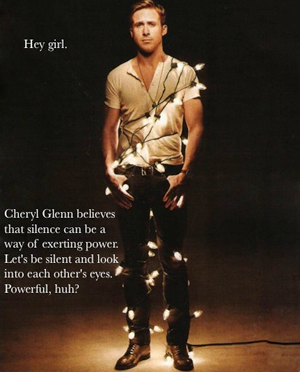
You could argue that Fb does have, like, a "Dislike" button – silence. When users see a post or content that they don't like, many simply choose to not click the "Like" button or comment or generate any type of response. Users could interpret this silence like they are pressing a “Dislike” button, but they could also interpret it as complicity or even absence. A user might think “Ryan Gosling probably liked my post but didn’t click the button – he's super busy after all.” Or, maybe, “Ryan Gosling probably didn’t see my post – he's really busy after all.” Cheryl Glenn (2004) talks a little bit about the rhetoric of silence. She says, "Whether choice or im/position, silence can reveal positive or negative abilities, fulfilling or withholding traits, harmony or disharmony, success or failure. Silence can deploy power; it can defer power. It all depends" (p. xi). So, like with "Like," silence is ambiguous too but it's way more ambiguous than "Like" cause silence isn't golden. Silence is_________. And that doesn't look golden does it? So "Dislike" is like silence on Fb. It isn't rhetorically golden and it's a lot like imagining Ryan Gosling "Likes" something we posted. Hey Gosling. Silence/"Dislike" is rhetorical but what the heck does it mean?
When discussing electronic information environments, McLuhan (2005) claims “Our new environment compels commitment and participation. We have become irrevocably involved with, and responsible for, each other” (p. 25). Without a "Dislike" button, users are denied a clearer rhetorical option to communicate “commitment and participation.” As discussed in the red petal, clickin' the “Like” button opens the possibility of commenting. It's a chain of events encouraging participation. So if I find I’m not, like, totally satisfied by simply “Liking” something, I can enforce my “Like” with a comment. In none of Ryan Gosling's words, I have the opportunity to clarify – to decrease the amount of ambiguity. Without a clickable "Dislike" button, silence or ___________is the promoted and coercive option. Without a "Dislike" button, Fb is gaslighting users into forgettin' that they can actually "Dislike" something and at least add a comment expressing dislike.
But wouldn’t a “Dislike” button make people feel bad? Maybe it would silence the likers and all the liking? Blogger Nicole Fabian-Weber argues
I can say with 100 percent honesty that the Internet is one of the meanest places I have ever set foot in… Would you walk up to a woman on the street and give a big ol' thumbs down in her face just for existing? Doubt it. But you certainly wouldn't hesitate to 'dislike' that same woman if there were a video of her on YouTube ... just cause.
She believes that Fb offers an escape from the sheer amount of negativity on other websites, so why would anyone change that by adding a “Dislike” button? Well, we think that Fb enforced “positivity” doesn’t necessarily translate into a positive social environment. When users must accept silence as the only option against “Liking," they are denied rhetorical agency or rhetorical power. The denial of “Dislike” is an implicitly negative rhetorical consequence of only having "Like." The negativity that everyone fears already exists because Fb is coercing users to click "Like" and silence "Dislike." It's sort of like voting for best actor at the academy awards from this list: The Notebook, Drive, The Ides of March, Blue Valentine, and Lars and the Real Girl. Though we wouldn't have a problem with this sort of voting system, we do wonder if it's the ethical move for Fb to clear things up? And wouldn’t users feel better if we could end the silence and click our dislikes? There are, after all, some movements: The Dislike Button Movement and Dislike Button (this one even has links to browser plugins for "Dislike" buttons that get around Fb's rules.)
DislikeLessons
To “Dislike” is a metonym.
To “Dislike” is tangible.
To “Dislike” is like silence.