Metamodernity—that is, the ability to hold postmodern cynicism with modern sincerity at once—is highly rhetorical. Michial Farmer explains metamodernism as sincerely striving for a utopian ideal (the modern view) while simultaneously remaining cynical (the postmodern view), acknowledging the utopia is doomed to fail. These competing worldviews, existing in concert, imbue texts with a peculiar rhetorical framework. If the metamodernist seeks to persuade—to strive toward the ideal knowing it is likely to fail—tropes and rhetorical appeals take on unique purpose, one of persuasion with acknowledgement of an argument’s flaws. The metamodernist engages in the art of persuasion (arguing for the ideal), while simultaneously undercutting zemself with the admission that the ideal is impossible to achieve. It is not the outcome that the metamodern rhetorician argues for but the process—a process, at least, of moving toward an action.
The editorial board of the web magazine (which includes leading metamodern scholars Robin van den Akker and Luke Turner), Notes on Metamodernism, describe this metamodern process as a “structure of feeling,” “the different ways of thinking vying to emerge at any one time in history” (“Structures of Feeling”):
The metamodern structure of feeling evokes an oscillation between a modern desire for sense and a postmodern doubt about the sense of it all, between a modern sincerity and a postmodern irony, between hope and melancholy and empathy and apathy and unity and plurality and purity and corruption and naïveté and knowingness...Indeed, metamodernism is an oscillation. It is the dynamic by which it expresses itself. One should be careful not to think of this oscillation as a balance however; rather it is a pendulum swinging between numerous, innumerable poles. Each time the metamodern enthusiasm swings towards fanaticism, gravity pulls it back towards irony; the moment its irony sways towards apathy, gravity pulls it back towards enthusiasm. (“What is Metamodernism?”)
Luke Turner further points out how the “metamodern generation understands that we can be both ironic and sincere in the same moment; that one does not necessarily diminish the other.” 1
Tawfiq Yousef underscores the importance and relevance of metamodernism, describing its emergence as a scholarly pivot from postmodernism:
When postmodernism began to falter as an intellectual and cultural system, a strong call for a new critical and cultural sensibility began to emerge. Since the 1990s, several conferences and many critical studies have dealt with the transition from the postmodern to the metamodern era expecting or announcing the end of postmodernism. (34)
Yousef observes a trend in the field of literary theory toward metamodernism—one that is particularly beneficial to analyzing the intersections of sexism, masculinity, feminism, and media. He explains that metamodernism does not discount modernism or postmodernism, but is instead the result of necessary adaptation that allows for a more complete analysis of texts:
Metamodernism is an inclusive discourse articulating the ongoing intellectual and cultural developments for which neither the postmodern nor the modern critique is adequate. Metamodernism synthesi[z]es the best qualities of modernism and postmodernism. Despite the apparent demise of postmodernism and modernism, their strategies and ideological critiques continue to live on in metamodernism. (41)
Expanding on Yousef’s observation, Freinacht notes that while “Postmodernism... was concerned with being an antithesis, with questioning what we take for granted… Metamodernism instead sees itself as a...protosynthesis, (a ‘proto’-synthesis because it acknowledges that whatever story we tell ourselves, it must be inconsistent and temporary)” (Freinacht). In other words, metamodernism is self-aware, creating a means of analysis that acknowledges the necessity of adaptation in order to maintain relevance, while still utilizing established practices as they remain applicable to criticism.
Metamodernism is, thus, a useful lens for understanding our current rhetorical moment. It embraces not just the artificiality of construction in a postmodern sense but also the lived authenticity of construction in a modern sense. A metamodernist perspective is useful for examining what it means to be authentically artificial and artificially authentic simultaneously. It is a structure of feeling very connected to intersectionality and equality, acknowledging how different positions (e.g., social classes) oscillate in importance for different audiences, yet are both/and aspects of identity, which have more than theoretical consequences for equality.
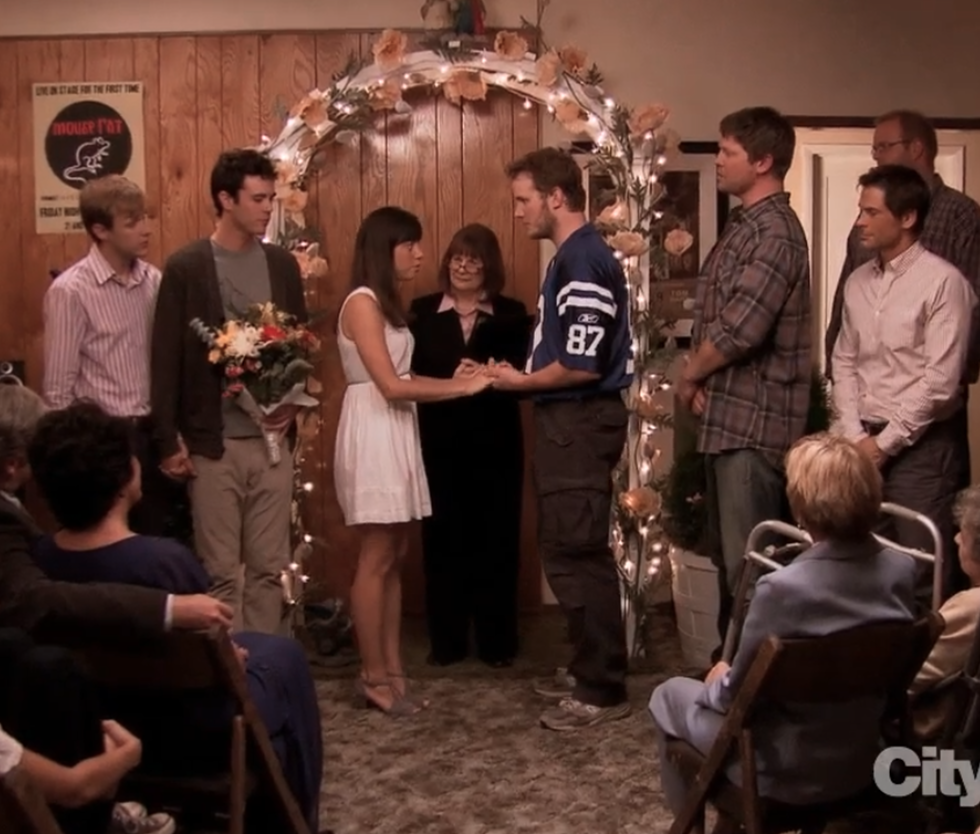
As a whole, Parks and Recreation expresses what Michial Farmer calls a “metamodernist sensibility” (103). The show, as Farmer points out, balances postmodern cynicism with modern sincerity, oscillating between them, holding both positions at once. April and Andy’s—who are Tom’s coworkers—relationship is allegorical of such a sensibility. April might be said to represent postmodernism with her cynicism and sarcasm, seemingly always aware of subtext and irony. Andy, meanwhile, seems more modern, perhaps even Victorian, in his sincerity—believing fully in the metanarrative of marriage. Farmer writes,
The two [April and Andy] balance each other out—or, to put it in metamodernist terms, their marriage is an oscillation between the poles of sincerity and irony. “I guess I kind of hate most things” says April during her wedding vows, “but I never really seem to hate you.” (116)
Andy’s vows, on the other hand, are less meta-level and, though not exactly traditional, reflect a more modern perspective:
Andy responds to April by nodding his head like an excited toddler and reading his own vows: “April, you are the most awesome person I have ever known in my entire life. I vow to protect you from danger; and I don't care if I have to fight an ultimate fighter, or a bear…” (116)
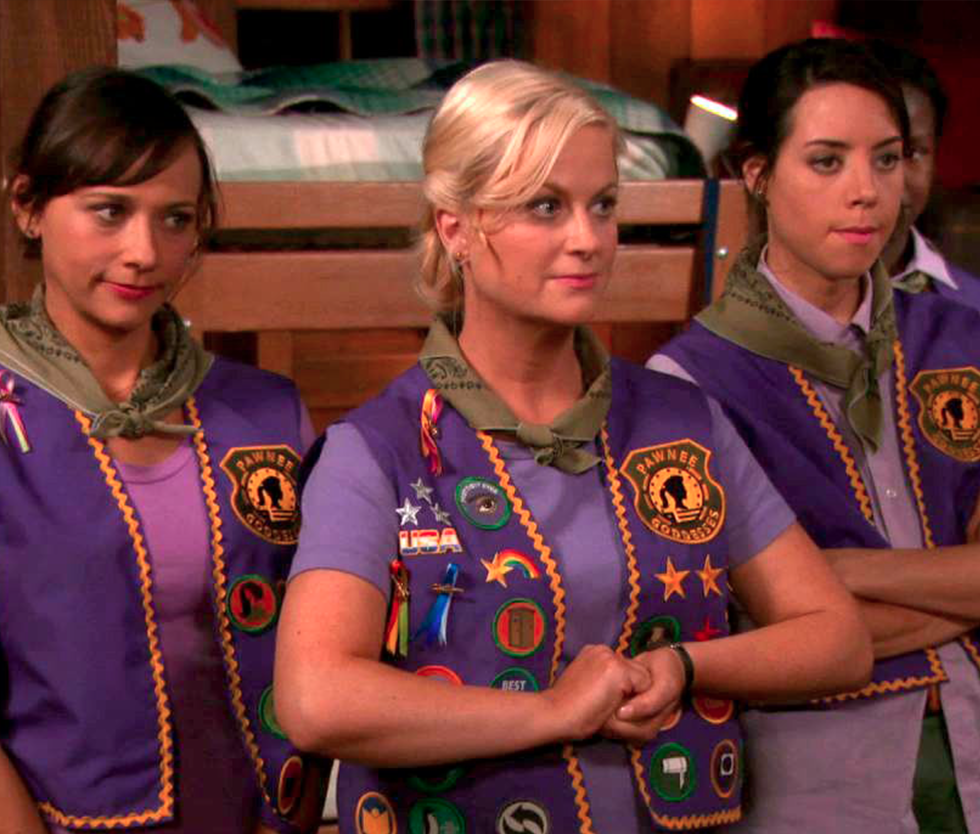
While April and Andy may separately embody the metamodern tension between idealism and cynicism, Gry Rustad connects Leslie Knope, the show’s lead character, to an oscillating feminism that illustrates metamodernity on an individual level. Leslie’s character is portrayed as holding multiple feminist positions at once:
[Leslie] oscillates between nuclear notions of femininity (nurturing, hysterical irrationality, love object) and feminist ideals (empowerment, female bonding and independence). Leslie Knope is as such a perfect imperfect character, well rounded and complex, and a truly metamodern feminist.
For Rustad, Knope embraces a plurality of feminist perspectives. Rustad argues convincingly with an impressive knowledge of the show that Leslie is overall a metamodern character who embraces both second wave ideals (i.e., empowerment, female bonding, and independence) and ideals more aligned with third wave feminism (i.e., nurturing, hysterical irrationality, and love object).
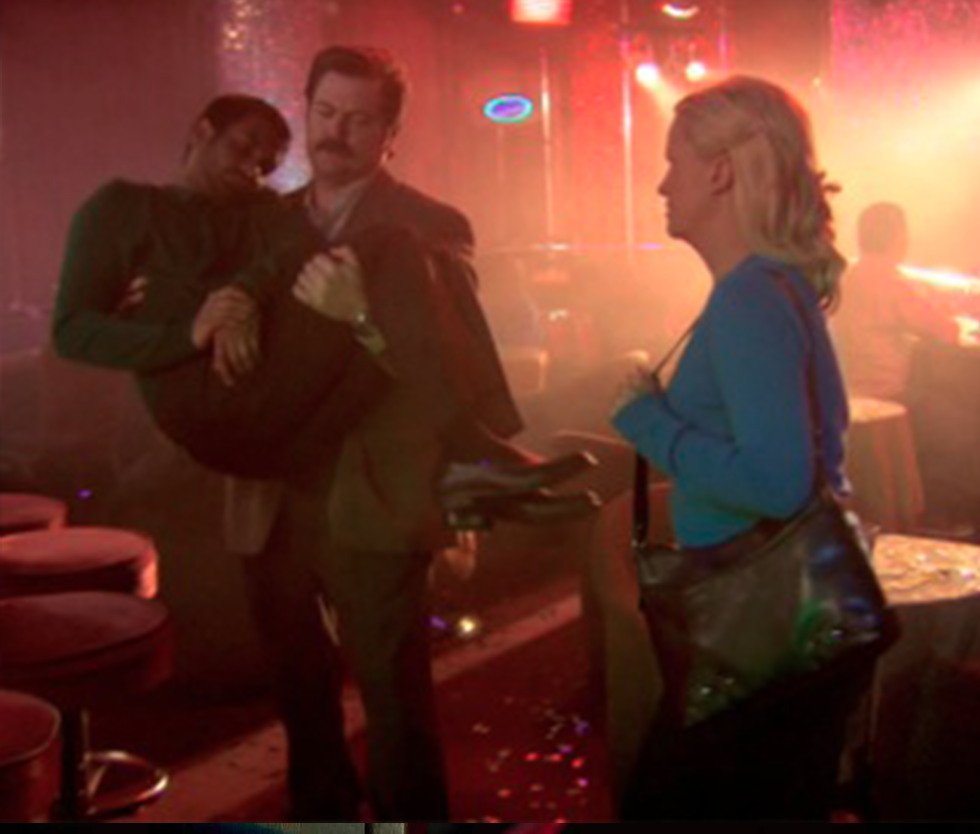
While Rustad’s overall assessment is astute, Leslie’s embrace of multiple feminist perspectives isn’t always consistent. Erika Engstrom discusses Leslie’s oscillation between feminist positions, analyzing her rhetorical and metamodern processing of feminism as an ideal. In “Tom’s Divorce,” for instance, where three of the show’s characters visit a strip club, Engstrom notes the tension between third and second wave sensibilities. In the episode, Leslie takes Tom—at his request—to the club to cheer him up. As Engstrom observes, while at the strip club, Leslie adopts a more third wave perspective, noting that for some feminists stripping is an empowering profession. At the same time, her behavior suggests she is struggling to accept that fact. At one point, she recruits a stripper to perform a lap dance on Tom to cheer him up, then offers the stripper the following advice: “and then afterwards maybe reconsider your profession.” Here Leslie projects a metamodern oscillation as she seeks to accept the potential empowerment of stripping, but ultimately, as Engstrom puts it, “she [Leslie] becomes a representation of the radical feminist perspective that holds stripping’s con’s [sic] outweigh any pro’s [sic]” (79). In this rhetorical situation, Leslie lists to one side, but she is authentically oscillating between perspectives, “trying” them out, and feeling both at once. In other words, Leslie is practicing metamodern rhetoric.
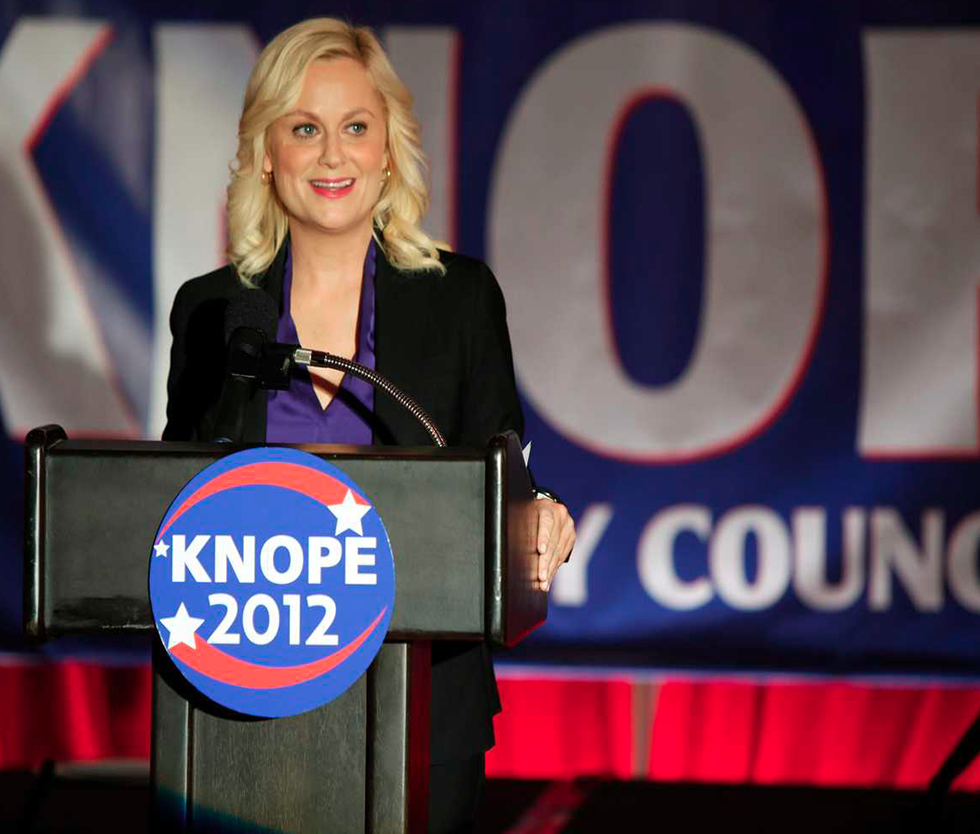
Leslie’s ability to embrace and “try out” multiple forms of femininity connects to another aspect of a metamodern sensibility: informed naivete. Metamodern critic and poet Seth Abramson comments on the optimistic aspect of metamodernism:
It’s an optimistic philosophy, but it’s a hard-won optimism that’s often called, by metamodernists, ‘informed naivete.’ Informed naivete is knowing your optimism is naive — but plowing on anyway.
Leslie “plows on anyway” in the face of patriarchy and the adversity it creates. Engstrom praises Leslie Knope for her optimism, noting that Leslie is aware of the flaws of government and the overwhelming challenges she faces in the patriarchal bureaucracy of Pawnee. She nevertheless pushes ahead in an effort to make her city better. Engstrom also argues that Pawnee itself can be seen as a representation of patriarchal culture’s inhibiting of women’s progress. Leslie Knope’s experiences with feminism and the consistent anti-feminist rhetoric from many others in the town support this notion. Unlike Leslie, the town’s patriarchs are never interested in a metamodern process. Rather, they remain modernist in their patriarchal views and actions.
1 To put it another way, if there was a trope that represented metamodernity, it would be adianoeta: it is “a kind of irony, since it uses terms that imply a different meaning than they denote; however, adianoeta counts on carrying both its meanings, playing off how different audiences will understand the same locution (one, literally; the other, ironically)” (“Adianoeta”). Both meanings are privileged and exist at once. A metamodernist approach accepts both meanings.

 Metamodernity, Feminism, & Rhetoric
 Parks & Rec. is Metamodern
 Metamodern Feminism
 Leslie Tries out Feminisms
 Metamodern Optimisms


