Parks and Recreation as a heuristic, as a persuasive manifestation of metamodern feminism, is complicated by Tom Haverford’s character. The informed naivete a metamodern structure of feeling enacts can also be said to foster an irresponsible naivete when it manifests in Tom’s portrayal of masculinity. Tom, like Leslie, can be considered a metamodern character. Tom’s metrosexual persona coupled with his sexist behavior reflects an oscillation between “non-traditional” masculinity (i.e., embracing femininity) and maintaining “traditional” or sexist views of women (i.e., a “straight-man” perspective focusing on women’s bodies as objects for sexual gratification).
As the “Sexist Tom Haverford” supercut shows, Tom’s sexist behavior is ubiquitous. Whether it is Sweetum’s CEO Jessica Wix, Pawnee Today host Joan Callamezo, or any of the numerous “beautiful” women in Pawnee, all can expect sexist comments about their appearance from Tom. The episode titled “Beauty Pageant,” unsurprisingly, is one where Tom’s typical behavior is on full display, exemplifying his views towards women. After finagling his way into becoming a judge for Pawnee’s annual beauty pageant, he states, “If you don’t call in favors to look at women in bikinis and assign them numerical grades, what the hell do you call in favors for?” Tom even refers to Trish Ianetta, the winner of the pageant, simply as “the hot one.” Here, he clearly ignores all of Trish’s other qualities and focuses solely on her physical beauty.
In contrast to his overt sexism, Tom’s metrosexuality and embrace of more traditionally feminine character traits is also ubiquitous. Tom is frequently portrayed with a highly refined taste for fashion and the “finer” things in life. He decorates and stocks his apartment with fine lotions, blankets, and coconut water (“Live Ammo”). His “Treat yo’ self” sprees (“Pawnee Rangers”), in which he and Donna—Tom’s coworker— take a day off to get pampered at a spa, display his “soft” sensibility. His business venture, “Rent-A-Swag,” where his shopping habits and taste in clothes become a means to supplement his income, emphasizes his fashion trendiness. Much to Tom’s dismay, in “Pawnee Zoo,” Leslie even articulates his “dandiness” by making a stereotypical—and unLeslie-like —observation: “I know that you are not gay, but you’re effeminate.”
In “Managing Masculinities: The Metrosexual Moment,” Helene Shugart situates metrosexualism historically, linking it to a growing sexualization of men’s bodies and conspicuous consumption through commercial masculinity, or the capitalizing of men as consumers (282). As Shugart explains, metrosexualism and other movements validating men’s participation in activities popularly seen as effeminate could result in “a leveling of the playing field” and alleviate some pressures of sexism on women (282). However, this “‘reconstruction of masculinity ... demonstrate[s] very few signs of postfeminist consciousness and many more indications of intensely sexuali[z]ed and phallocentric muscularity’’’ (Edwards qtd. in Shugart 283). Though metrosexual men take on traditionally feminine traits and are sexualized in media, masculinity continues to be centered in media and culture, and the myriad of oppressive structures imposed on women cannot be erased.
In their preface to Communicating Marginalized Masculinities: Identity Politics in TV, Film, and New Media, Ronald L. Jackson II and Jamie E. Moshin comment on what we feel is metrosexuality’s connection to metamodernity. In their brief history of metrosexuality as a concept, they note the following:
The rise of the metrosexual could be said to demark [sic] either the rewriting of concepts of masculinity, or the providing of an equally-valued alternative or the proliferating of the post-identity movement. It is this last aspect, the post-genderness of the metrosexual, that most attracts our attention here; it is this very post-ness, the willingness to transgress and to straddle barriers, that simultaneously reifies and strengthens those same barriers. (6−7)
And for us, this is what is most problematic: As a metrosexual, Tom stands in marked contrast to “manly” men and, thus, serves as a comic foil on the show. To be “funny,” the show counts on a value-system based on an authentic non-metrosexual masculinity. Tom’s character may be “post-gender” and metamodern in his dandiness but not in his behavior towards women, which is also used for comic effect.
Tom Haverford’s oscillation between two seemingly contradictory forms of masculinity is counterbalanced by Leslie’s “knowledge” of his authenticity. We view Tom through a double oscillation—between toxic masculinities and the “real” Tom, who isn’t really a jerk. Tom’s “real” self, in fact, assists him in being a humorous character, one audiences cheer for rather than revile.
Though not explicitly named, this kind of irresponsible naivete is an issue rhetorical theorists are discussing in relation to feminism. In 2011, rhetoric scholars Jennifer Sano-Franchini, Donnie Sackey, and Stacey Pigg interviewed colleagues Nan Johnson and Stacey Perryman-Clark on the concept of feminism. Johnson and Perryman-Clark explain:
Many feminists of her [Johnson’s] generation associate the term [feminism] with equality, valuing the voices of all, and making sure that everyone has a space in the conversation. However, as Perryman-Clark suggests, when “feminism” is perceived as a disciplinary or academic stance that includes only the interests of women—and perhaps a narrowly defined understanding of what it means to be a woman—this inclusivity is undermined. In turn,
feminism as a term in everyday use is associated for some with valuing all voices equally and for others with the fight for equality of a particular group that might exclude others. (Sano-Franchini et al.)
“Feminism” as it exists today might be said to oscillate similarly between informed naivetes and irresponsible naivetes. Informed naivetes are inclusive and place a value on action, with the understanding that even having a space at the table for a conversation doesn’t mean one will be heard or listened to. “Plowing ahead” and being equitable are part of the optimistic process of trying to create equal spaces in the face of patriarchy. Feminism, at the same time, can be irresponsible when it is words without action, belief without process, or when its actions are diminishing—for instance, focusing on white women’s interests without looking at larger intersectional issues. Leslie Knope oscillates between the two. She’s informed in her process to overthrow the patriarchy but irresponsible in accepting Tom’s sexism as not the “real” Tom: the “real” Tom, for Leslie, is feminist.

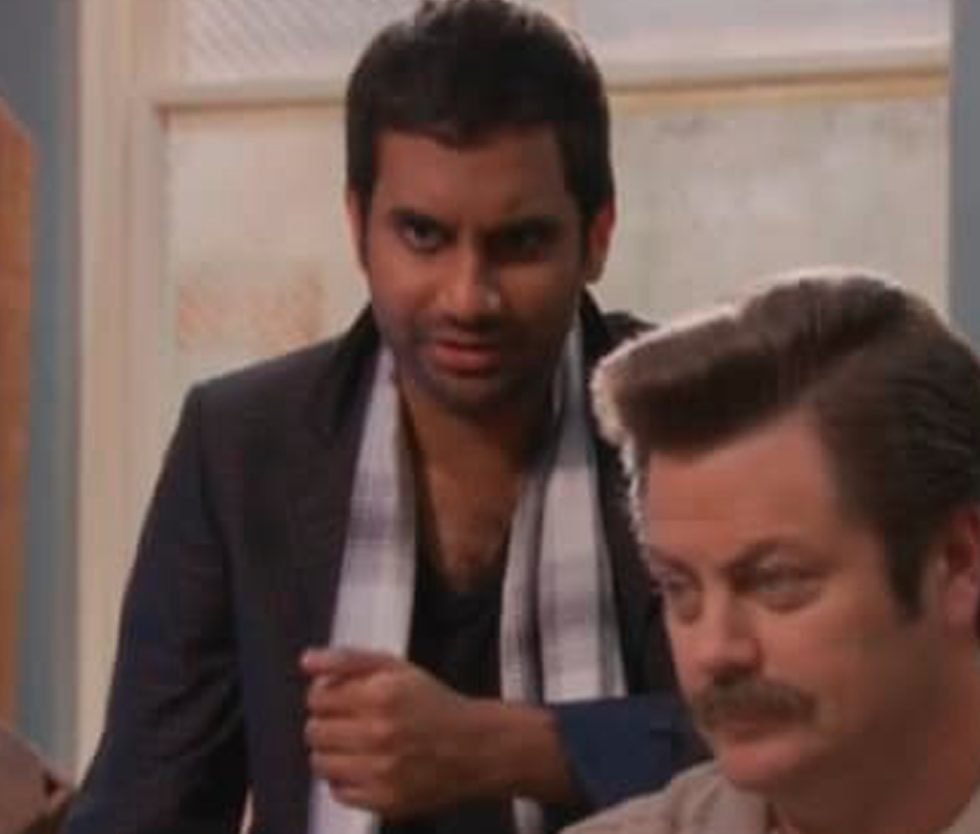 Irresponsible Naievete
 Metamodern Masculinity
 “Real” Tom
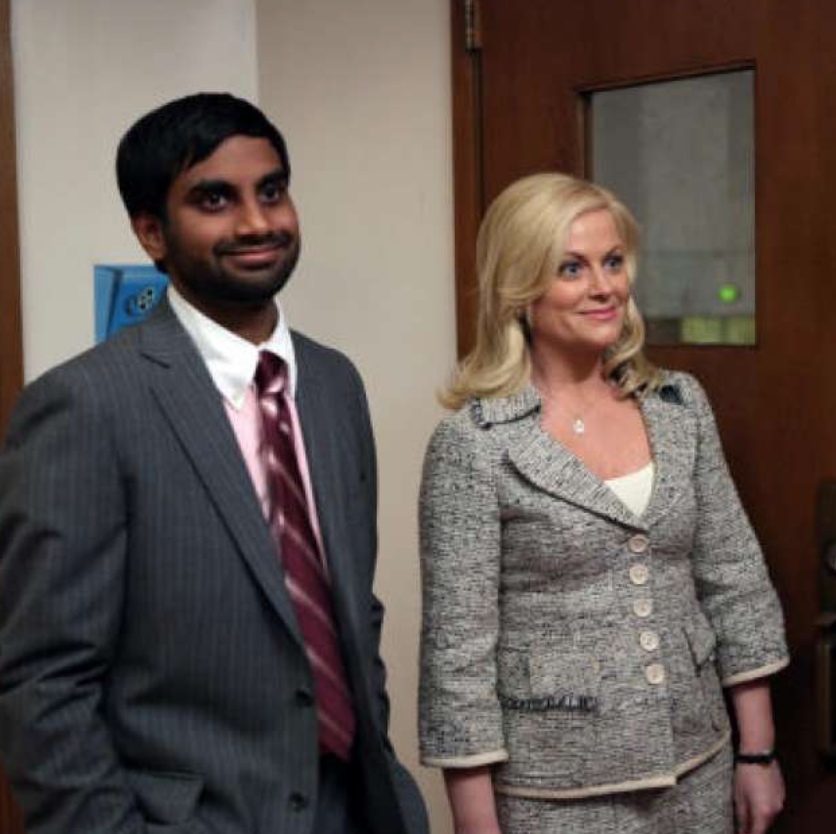 Conflicted Knope


