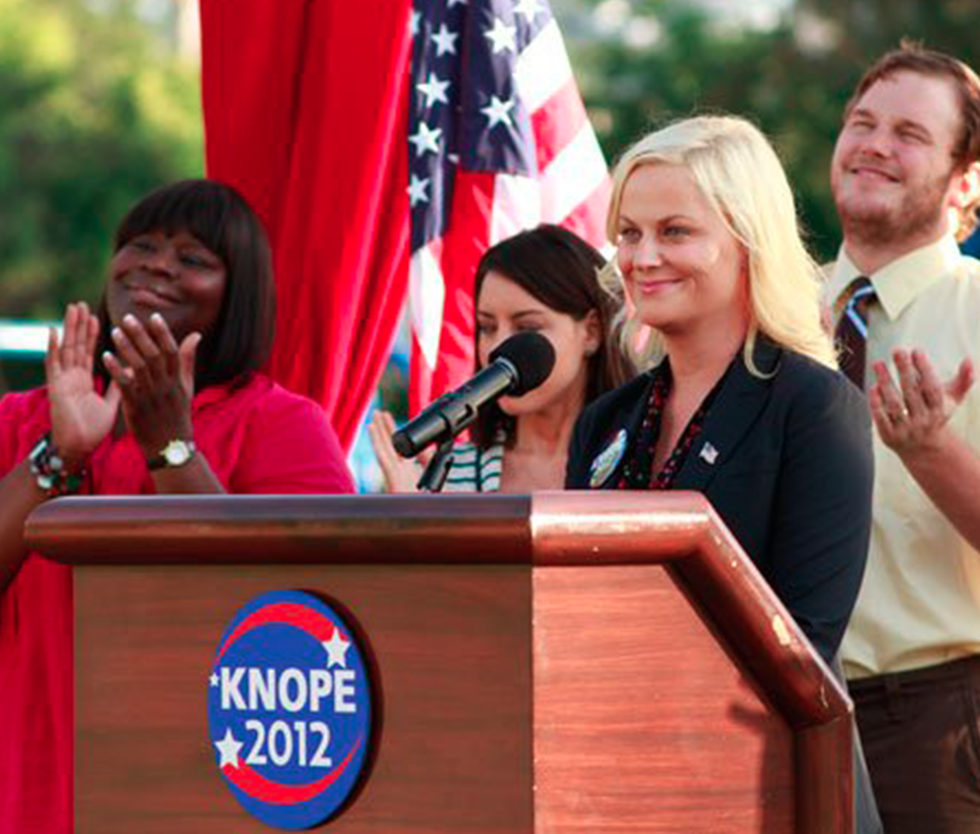
Parks and Recreation is an important television show with metamodern and feminist sensibilities. The show often does more than “believe” in feminism, with characters not only referencing feminist theory but taking on patriarchal structures and challenging the patriarchal status quo. The show even presents a number of more or less feminist men role models: Chris worries about objectifying Linda in “Lucky,” and he attempts to be more inclusive of women in government in “Women in Garbage.” Ben in “Pie-Mary” helps Leslie negotiate “the impossible tightrope women in high-visibility positions are asked to walk” (Ward) when two hyperbolic interest groups (a men’s rights group and Indiana’s Organization of Women) simultaneously criticize Leslie for being both too feminine and not feminine enough.
Engstrom points out the heuristic importance of these rhetorical turns in the narrative and how such turns are counter-hegemonic:
The tying of male characters to notable feminists and to the study of
feminism itself serves to normalize the idea that men not only (1) know
about feminists and feminism but (2) actually support feminists and feminism.
(65)
The issue with the show comes in the form of interpersonal relationships and “believing” in authenticity—in embracing Tom’s microaggressive humor as “natural” and excusable. Such a belief is a heuristic for what’s “okay” to tolerate (i.e., everyday, “lovable” sexism). His behavior is troubling because of how it is excused in a manner similar to the ways ironic advertising is excused because of its “wink”—because it’s not “real”—though it is, though it’s not. With Tom’s metamodern masculinity taken in the context of the show and his “true” self, it is difficult to find the credulity, the sincerity.
Though arguing about the rhetoric of consumerism, anti-consumerism, and how authenticity is rhetorically constructed as masculine, Robinson makes an important point about hegemonic masculinity: “The power of masculinity is secured, in part, by the fantasy that it is not constructed but natural, timeless, essential, and authentic” (46). She describes convincingly the existence of
a master narrative about [how] large social systems function to feminize men, and by extension the nation, by destroying authenticity [that] has long served to justify and legitimate a symbolic gender order in which all things masculine ‘trump’ all things feminine. (201)
Leslie takes part in this master narrative and fantasy but in an unexpected way. Tom, in the context and value system presented in the show, is both feminized and masculinized. Leslie’s belief in Tom’s authentic self, in his not “really” being sexist at heart, validates the master narrative in action. Tom isn’t really stereotypically masculine. He doesn’t really believe his actions. Leslie becomes complicit in maintaining the status quo because she doesn’t think his behavior is
authentic. Sexist behavior continues to “trump” all things feminine because the “feminine” and, for our purposes, “feminist” self is hidden in authentic belief.
Certainly, the concentration of Tom’s sexist statements is diluted as the series progresses and as our supercut shows. Nevertheless, “believing” in feminism without acting in accordance to those beliefs is counterproductive to gender equity. In fact, it might be said to be a “Goldilocks move” to care just enough or “just right” to suppress advocacy. Throughout Parks and Recreation, Tom Haverford’s character creates feminist and racial tensions: there are times he does the “right” thing and is helpful. However, his fundamental pattern of behavior, including the regular objectification of women and treating women as sex objects, is made “loveable.” And since white characters are overwhelmingly “more” feminist, non-white Tom is safely “peeping” sexism as an Other, who may or may not “truly” be sexist. Non-whites get away with sexism and are deemed harmless or ineffectual at the same time.
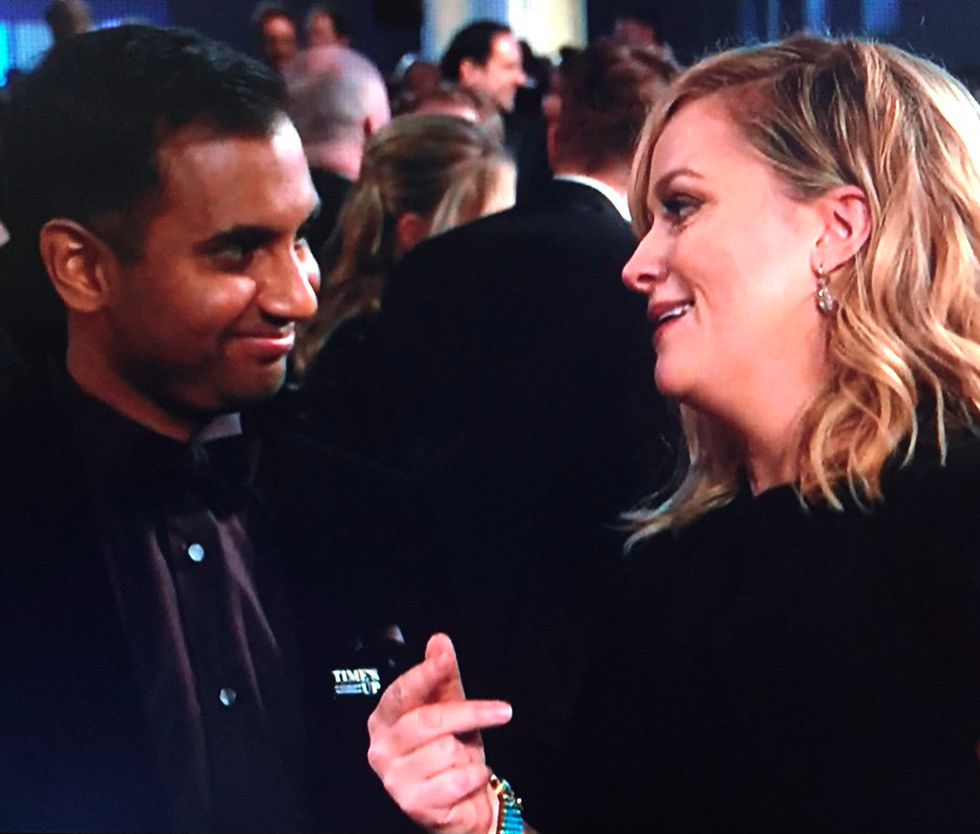

While paying lip service to a belief is easy, taking difficult rhetorical actions that matter and are more likely to make an actual difference—like those sharing their experiences in #MeToo and #TimesUp—is not. Many of the stars of Parks and Recreation (Chris Pratt, Amy Poehler, Nick Offerman, and Aubrey Plaza) are supportive of a reboot or reunion (McDonald). Hopefully, should a reboot occur, Tom Haverford’s character can change. No person and no character is stagnant. Just as people learn and evolve over time so too can characters. The difference is that characters such as those in Parks and Recreation are carefully crafted and are granted influence to communicate messages about appropriate behavior, thus shaping behaviors of others through their privileged place in prime time media. This privilege, then, means producers and actors must take seriously their responsibilities as influencers and accept scrutiny. In summary, we see Tom’s character, as well as other characters’ responses to his behavior, as problematic because he is given a free pass to mistreat women. Such behaviors onscreen suggest it is acceptable offscreen to engage in behaviors that allow people to pass as feminist while still upholding oppressive sexist structures.
For Parks and Recreation, putting belief into action would mean developing the character away from a metamodern masculinity that oscillates between non-traditional masculinity (i.e., embracing femininity) and traditional masculinity with regards to sexism. Instead, Tom’s character might become one who is more powerful, that parallels Leslie’s metamodernity. We’d like to see a new Tom who offers a masculinity that is both “traditionally” masculine and non-traditionally masculine. We’d like to see a Tom who expresses femininity (nurturing, hysterical irrationality, love object) and more “traditional” masculine/feminist ideals (empowerment, bonding between women, and independence). This is a type of masculinity one can “believe” in and advocate for, and it would be a rhetorical process worth seeing.

 More than Belief
 Authenticity as Rhetorical Move
 IRL Feminism is Action
 Rebooting Masculinity


